
PT 141 10mg
$55.00
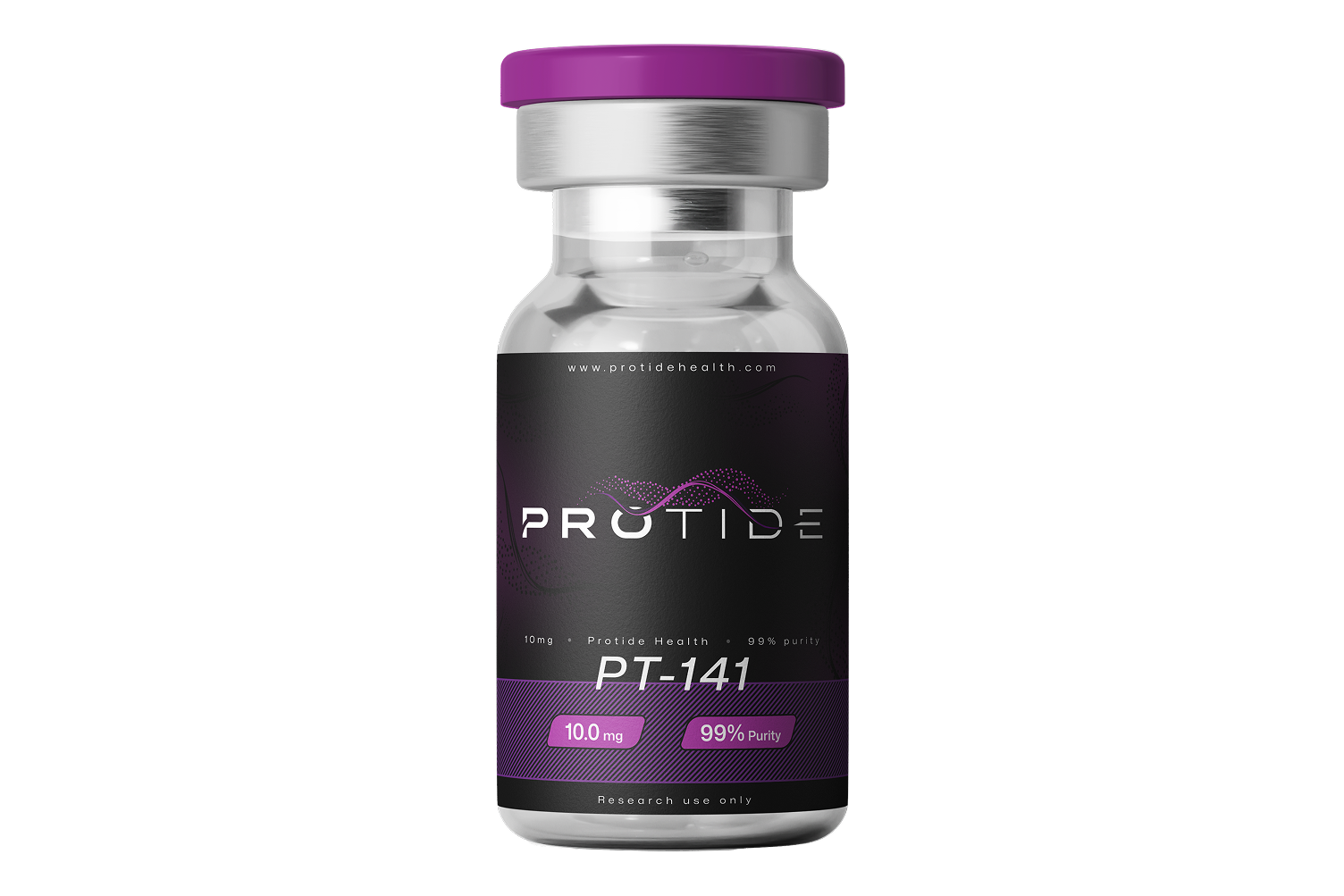
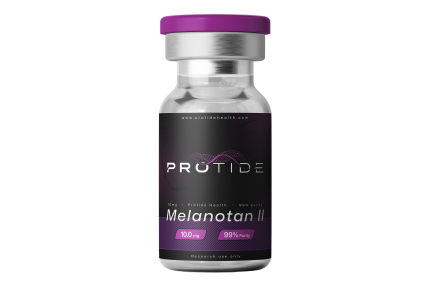
PT 141 peptide 10mg product shot featuring a professionally labeled Protide Health 3mL research vial containing white to off-white lyophilized bremelanotide material, with the 10mg strength, cyclic melanocortin peptide identity, and research-use-only labeling clearly displayed against a clean laboratory-style background.


PT 141 Peptide 10mg – Protide Health USA
PT 141 Overview & Technical Specifications
PT 141, also known as bremelanotide, is a synthetic cyclic heptapeptide derived from melanocortin peptide research.
It is structurally related to α-melanocyte-stimulating hormone analogues and is characterized by the sequence:
Ac-Nle-cyclo[Asp-His-D-Phe-Arg-Trp-Lys]-OH
The cyclic structure is formed through the Asp and Lys residues, producing the conformationally constrained melanocortin analogue commonly identified as PT-141 or bremelanotide.
The supplied PT-141 PubChem chemical record identifies the free-base molecule as PubChem CID 9941379, CAS 189691-06-3, molecular formula C50H68N14O10, and molecular weight approximately 1025.18 g/mol.
Protide Health supplies PT 141 as 10mg of 99% purity lyophilized material in a 3mL vial for controlled melanocortin-receptor, biochemical, cellular, molecular, analytical, and qualified preclinical research.
Technical Specifications
- Product Name: PT-141
- Alternative Name: Bremelanotide
- Quantity: 10mg
- Form: Lyophilized powder
- Vial Size: 3mL
- Purity: 99%
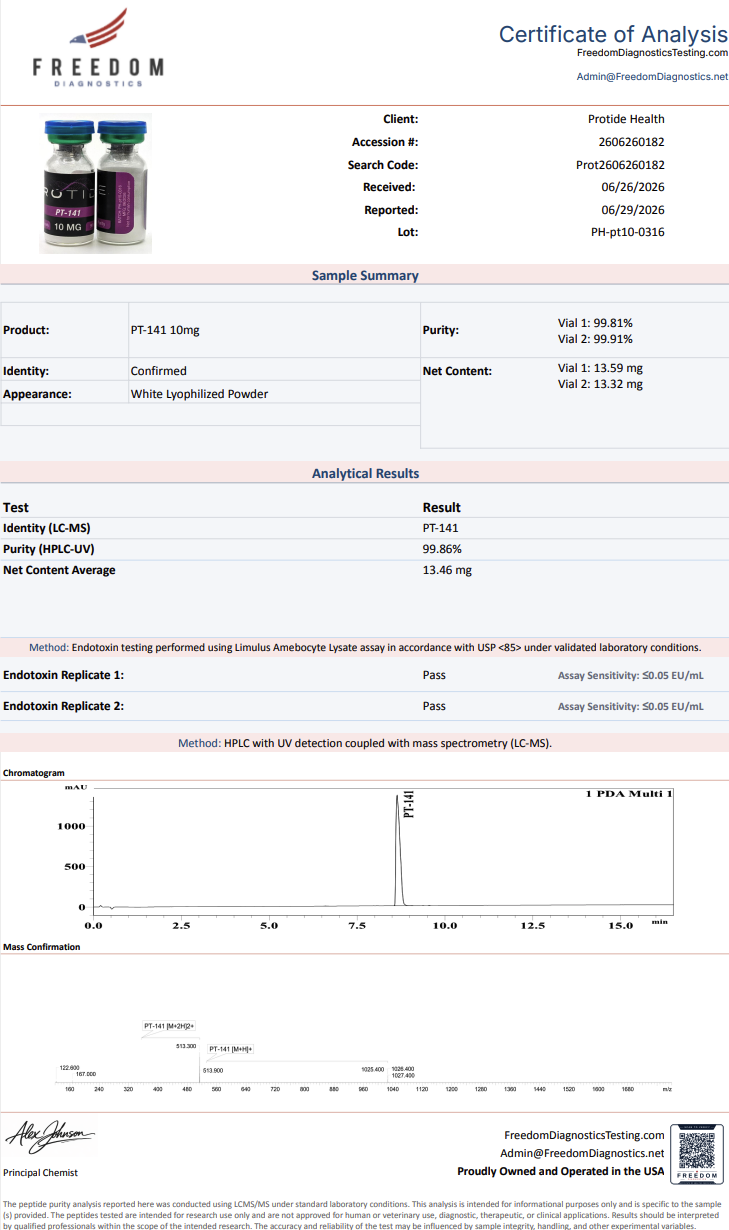
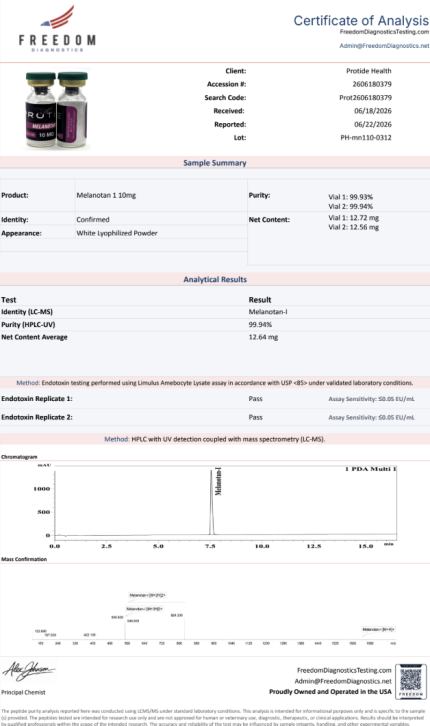
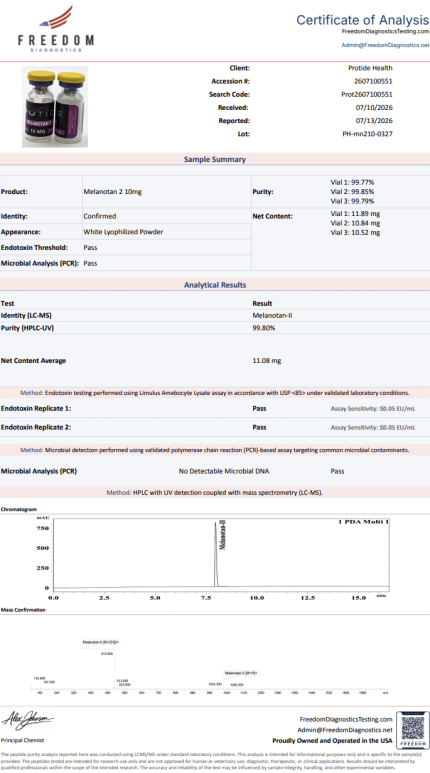
- Testing: HPLC-MS verified; third-party tested
- Peptide Type: Synthetic cyclic heptapeptide melanocortin receptor agonist
- Structural Class: α-MSH analogue
- Sequence: Ac-Nle-cyclo[Asp-His-D-Phe-Arg-Trp-Lys]-OH
- CAS Number: 189691-06-3
- PubChem CID: 9941379
- Molecular Formula: C50H68N14O10
- Molecular Weight: Approximately 1025.18 g/mol
- Appearance: White to off-white lyophilized powder
- Solubility: Soluble in water and DMSO
- Storage: Store sealed at ≤6°C and protected from heat, light, and moisture
- Research Use: Melanocortin-receptor, biochemical, cellular, neuroendocrine, analytical, and qualified preclinical research only
Researchers examining molecular conformation can also reference the supplied PT-141 chemical structure.
PT 141 Peptide Mechanism & Melanocortin Research
The principal research interest surrounding PT 141 concerns its activity at melanocortin receptors.
The melanocortin receptor family consists of five G protein-coupled receptors:
- MC1R
- MC2R
- MC3R
- MC4R
- MC5R
Bremelanotide has agonist activity at multiple melanocortin receptor subtypes, with particular experimental attention historically directed toward MC3R and MC4R.
These receptors participate in central signaling networks associated with:
- Hypothalamic signaling
- Neuroendocrine regulation
- Appetite-related pathways
- Autonomic signaling
- Behavioral responses
- Reproductive neurobiology
Researchers can review broader PT-141 and bremelanotide research indexed by PubMed for peer-reviewed work involving melanocortin pharmacology, receptor activation, neuroendocrine systems, and clinical-development history.
Melanocortin Receptor Signaling Research
Melanocortin receptors are class A G protein-coupled receptors.
Receptor activation can influence intracellular signaling through pathways involving:
- Gs proteins
- Adenylate cyclase
- Cyclic AMP
- Protein kinase A
- Downstream transcriptional responses
- Hypothalamic neuronal activity
Experimental PT 141 peptide research has therefore focused on central melanocortin signaling rather than the nitric-oxide-dependent peripheral mechanisms associated with some other compounds studied in reproductive physiology.
This distinction is important when comparing PT-141 with unrelated experimental compounds.
MC3R & MC4R Research
Early pharmacology studies identified MC3R and MC4R as important receptors in the biological response to PT-141.
MC4R is extensively studied in central nervous system pathways involving:
- Energy balance
- Appetite regulation
- Autonomic function
- Neuroendocrine signaling
- Behavioral responses
MC3R has overlapping but distinct physiological and neurological roles.
The activity of PT 141 across more than one melanocortin receptor means research findings should not automatically be attributed to a single receptor subtype without appropriate receptor-selective controls.
PT 141 and α-MSH Analogue Research
PT-141 originated from melanocortin analogue development and is structurally related to melanotan compounds.
α-MSH is an endogenous melanocortin peptide derived from proopiomelanocortin.
Structural modification of melanocortin peptides has been used experimentally to study:
- Receptor selectivity
- Peptide stability
- Cyclic peptide conformation
- Central nervous system signaling
- Structure-activity relationships
The cyclic heptapeptide structure of PT 141 peptide differs significantly from endogenous α-MSH and should be treated as a separate molecular entity.
PT-141 vs Melanotan Peptides
PT-141 and melanotan compounds belong to the broader melanocortin research family, but they are not interchangeable.
Researchers comparing melanocortin systems may review Melanotan 1 10mg for a distinct α-MSH analogue with a different structure and receptor profile.
The Melanotan 2 MT-2 10mg research peptide represents another cyclic melanocortin analogue with chemical and pharmacological differences from PT-141.
Differences in sequence, receptor affinity, pharmacokinetics, and experimental design must be considered when interpreting results across melanocortin analogues.
PT-141 Nasal Spray Research Context
The keyword pt-141 nasal spray originates partly from early clinical-development research.
Early human studies evaluated intranasal bremelanotide formulations in controlled experimental settings.
These investigations examined:
- Pharmacokinetics
- Melanocortin-associated responses
- Dose-response relationships
- Cardiovascular monitoring
- Experimental behavioral endpoints
- Adverse-event reporting
The Protide Health product described here is not a PT-141 nasal spray.
It is supplied as lyophilized laboratory research material and is not formulated, packaged, or represented as an intranasal pharmaceutical product.
Historical intranasal study results should not be used to infer appropriate preparation or administration of this research vial.
PT 141 Nasal Spray vs Research Vial
Searches for pt 141 nasal spray may also lead to compounded or commercially promoted products.
Those preparations can differ in:
- Chemical form
- Concentration
- Excipients
- pH
- Delivery device
- Formulation stability
- Regulatory status
A 10mg research vial therefore should not be treated as equivalent to any formulated nasal-spray product.
Protide Health provides no nasal formulation or administration instructions.
PT 141 Dosage Searches & Research Use
The phrase pt 141 dosage concerns human pharmaceutical administration and does not describe the intended use of this research product.
The 10mg stated on this page represents the total amount of laboratory research material in the vial.
It is not a recommended human dose.
Protide Health does not provide:
- Human dosage schedules
- Injection instructions
- Intranasal dosing
- Dose-per-body-weight calculations
- Treatment cycles
- Sexual-function protocols
- Reconstitution instructions for human administration
Published pharmaceutical studies use specific regulated formulations and protocols that should not be applied to independently supplied laboratory material.
Clinical Bremelanotide vs Protide Health PT-141
Bremelanotide has progressed further clinically than many experimental research peptides.
The active ingredient is used in an FDA-approved prescription product for a specific indication in premenopausal women with acquired, generalized hypoactive sexual desire disorder.
That does not mean every material labeled bremelanotide or PT 141 is an FDA-approved drug.
The Protide Health product:
- Is supplied as a 10mg research vial
- Is lyophilized
- Is intended for laboratory experimentation
- Is not the FDA-approved Vyleesi formulation
- Is not supplied in an approved autoinjector
- Is not marketed for treatment of any medical condition
This distinction is essential for accurate regulatory positioning.
Clinical Research & Experimental Outcomes
Clinical-development studies of regulated bremelanotide have investigated endpoints involving sexual desire and distress in specific defined populations.
Earlier studies also examined experimental outcomes in male participants and used intranasal formulations.
Those results apply to the preparations, populations, doses, and routes evaluated in those studies.
They do not establish therapeutic efficacy for a Protide Health research vial.
Furthermore, regulatory labeling specifically distinguishes the approved indication from generalized sexual-performance enhancement.
PT 141 Safety & Research Limitations
Clinical studies of pharmaceutical bremelanotide have reported adverse events including nausea and flushing, and regulatory evaluation has also considered transient blood-pressure changes associated with melanocortin receptor activation.
Such information relates to regulated pharmaceutical research and should not be interpreted as a safety profile for independently supplied research material.
Important limitations include:
- Route of administration affects pharmacokinetics.
- Clinical formulations differ from laboratory-grade material.
- Melanocortin receptor activation is not limited to one receptor subtype.
- Clinical findings from defined patient populations cannot be generalized universally.
- Preclinical animal findings do not establish equivalent human outcomes.
- Early intranasal studies do not establish the suitability of a laboratory vial for nasal use.
- The FDA-approved drug product is chemically formulated and regulated separately from this product.
Accordingly, PT 141 should be handled strictly as a research compound.
Research Format & Storage
Protide Health supplies PT 141 as white to off-white lyophilized powder in a 3mL vial.
The supplied specifications state:
- Quantity: 10mg
- Purity: 99%
- HPLC-MS verified
- Third-party tested
- Soluble in water and DMSO
For storage:
- Store at ≤6°C
- Keep sealed
- Protect from heat
- Protect from direct light
- Protect from moisture
These are laboratory product specifications and not preparation instructions for administration.
Literature & Citation Index
PT-141: A Melanocortin Agonist for the Treatment of Sexual Dysfunction
Year: 2003
PMID: 12851303
DOI: 10.1111/j.1749-6632.2003.tb03167.x
Research Context: Early PT-141 research, α-MSH analogue pharmacology, MC3R/MC4R signaling, animal experiments, and initial clinical investigation.
Double-Blind, Placebo-Controlled Evaluation of Intranasal PT-141
Year: 2004
PMID: 14963471
Research Context: Intranasal pharmacokinetics, pharmacodynamic measurements, controlled human research, and adverse-event monitoring.
Effect on the Subjective Sexual Response in Premenopausal Women With Sexual Arousal Disorder by Bremelanotide
Year: 2006
PMID: 16839319
Research Context: MC3R/MC4R agonism, intranasal bremelanotide, controlled human experimental measurements, and female sexual-arousal research.
Usefulness of Ambulatory Blood Pressure Monitoring to Assess the Melanocortin Receptor Agonist Bremelanotide
Year: 2017
PMID: 27977473
DOI: 10.1097/HJH.0000000000001221
Research Context: MC4R-associated cardiovascular monitoring and transient blood-pressure changes in controlled clinical studies.
Safety Profile of Bremelanotide Across the Clinical Development Program
Year: 2022
PMID: 35147466
DOI: 10.1089/jwh.2021.0191
Research Context: Integrated pharmaceutical safety data from clinical development, including phase 1 through phase 3 research.
Frequently Asked Questions
What is PT 141?
PT 141 is bremelanotide, a synthetic cyclic melanocortin-receptor agonist derived from α-MSH analogue research.
What is the PT-141 peptide sequence?
The sequence is represented as:
Ac-Nle-cyclo[Asp-His-D-Phe-Arg-Trp-Lys]-OH
What is the molecular formula of PT-141?
The free-base molecular formula is C50H68N14O10, with molecular weight approximately 1025.18 g/mol.
What is the CAS number for PT-141?
The CAS number for bremelanotide free base is 189691-06-3.
What is the PubChem CID?
The PubChem identifier is CID 9941379.
What receptors does PT-141 interact with?
PT-141 is a melanocortin-receptor agonist. Research has particularly examined MC3R and MC4R, although bremelanotide has activity across multiple melanocortin receptor subtypes.
Is PT-141 FDA approved?
Bremelanotide is the active ingredient in an FDA-approved prescription drug for a defined indication. However, Protide Health PT 141 10mg is not that FDA-approved drug product and is supplied exclusively for laboratory research.
Is this a PT-141 nasal spray?
No. This product is lyophilized research material and is not supplied as a pt-141 nasal spray.
What is the PT 141 dosage?
Protide Health does not provide a human pt 141 dosage. The 10mg amount identifies vial contents for laboratory research and is not a recommended dose.
What purity does Protide Health specify?
The product specification states 99% purity, with HPLC-MS verification and third-party testing.
What form is PT-141 supplied in?
PT 141 is supplied as 10mg of white to off-white lyophilized material in a 3mL research vial.
Is PT-141 intended for human use?
No. This product is supplied exclusively for melanocortin-receptor studies, biochemical experiments, cellular research, analytical testing, in-vitro studies, and qualified preclinical research.
Laboratory Terms & Compliance
Laboratory Research Use Only
This product is supplied exclusively for laboratory research, analytical testing, in-vitro studies, preclinical research, receptor studies, and qualified scientific experimentation.
It is not intended for human or veterinary consumption, medical use, diagnostic use, therapeutic use, sexual-function treatment, performance enhancement, nasal administration, injection, or clinical administration.
No human dosage, injection protocol, nasal-spray formulation, administration schedule, treatment recommendation, or preparation instructions are provided.
The purchaser is responsible for appropriate laboratory handling, storage, and use under applicable institutional, federal, state, and local requirements. Please review the Protide Health Terms & Conditions before purchasing.
For research use only.


MAECENAS IACULIS
Vestibulum curae torquent diam diam commodo parturient penatibus nunc dui adipiscing convallis bulum parturient suspendisse parturient a.Parturient in parturient scelerisque nibh lectus quam a natoque adipiscing a vestibulum hendrerit et pharetra fames nunc natoque dui.
ADIPISCING CONVALLIS BULUM
- Vestibulum penatibus nunc dui adipiscing convallis bulum parturient suspendisse.
- Abitur parturient praesent lectus quam a natoque adipiscing a vestibulum hendre.
- Diam parturient dictumst parturient scelerisque nibh lectus.
Scelerisque adipiscing bibendum sem vestibulum et in a a a purus lectus faucibus lobortis tincidunt purus lectus nisl class eros.Condimentum a et ullamcorper dictumst mus et tristique elementum nam inceptos hac parturient scelerisque vestibulum amet elit ut volutpat.
Reviews
There are no reviews yet.